Tuesday, October 3, 2023

LET US GLANCE AT OUR GAZETTEER

Over the course of this year, I've written three short essays about Arthur Conan Doyle for inclusion in the Sherlock's Spotlight Gazette published by The Beacon Society for young readers. As I begin work on the final essay for this 2023, I decided to post the previous three to this site, beginning with, appropriately, "The Beginnings of a Storyteller."

About Arthur, the Author

Glimpses into the life of Sir Arthur Conan Doyle, creator of Sherlock Holmes

The Beginnings of a Storyteller

Arthur Conan Doyle, creator of Sherlock Holmes and Dr. Watson, first wrote a mystery about them in 1886. He was twenty-seven years old. He authored many stories and created many characters before Holmes and Watson. His storytelling actually began when he was a young boy living in a boarding school.

              At the age of nine, he left his family in Scotland, traveling by train alone, to live in England at a school called Hodder. He lived at Hodder for two years, and then moved to a nearby school for older boys called Stonyhurst, for another five years. During those seven years, he only saw his family during summer break. The school did not have other breaks during the year. Except for the six-week vacation in the summer, the boys never went home.

              He was sometimes lonely, but he discovered that he had what he called “some literary streak” that was not common to the other boys in his school. He created stories about heroes and their adventures, which he shared. The other students were thrilled by Arthur’s storytelling.

              An audience of young boys would sit on the floor, their chins on their hands, and listen as Arthur, standing on a desk before them, would tell stories until his voice grew husky. Remember: the school had no televisions, no computers, no internet, and no telephones. For them, the story time with Arthur was like going to a movie.

              He learned to tell a story in an entertaining way from his mother. Mary Doyle loved to read, and she had a natural gift for telling Arthur and his brother and sisters thrilling tales about the characters in the books she read. “In my early childhood, as far back as I can remember anything at all,” he wrote many years later, “the vivid stories which she would tell me stand out so clearly that they obscure the real facts of my life.”

              During the summer holidays, he would read many books he borrowed from the small library near his home. He read so many so quickly that the librarians had to tell his mother that Arthur was limited to exchanging books only twice a day! When he went back to school, he had many more adventure stories he could share. The reading inspired him to create his own stories for his school friends.

              Arthur’s storytelling gave him an added bonus: treats! His schoolmates enjoyed his stories so much they would at times bribe Arthur to keep talking by giving him pastries or apples. The students ate very plain meals. For breakfast, they had a bit of dry bread and hot watered milk. For lunch (they called it dinner), there was a little beef and fish on Fridays. For a snack in the afternoon, they had dry bread again with an odd brown drink that was called “beer” because of its color, but it was not really beer. For supper, they had hot milk again, bread, butter, and sometimes potatoes. A treat such as a pastry or an apple was rare and special. The boys found his stories to be worth the price.

              Arthur Conan Doyle was on his way to becoming the storyteller who would later entertain millions of people.

Wednesday, August 30, 2023

MY MIND REBELS

Sherlock Holmes famously told Dr. Watson "My mind rebels at stagnation. Give me problems, give me work, give me the most abstruse cryptogram, or the most intricate analysis, and I am in my own proper atmosphere." Lucky Holmes. I have found that my mind tends to rebel against its proper function at times and seemingly enjoys a nice long period of stagnation. I've been struggling to get back in to a pattern of studying and writing everyday after taking a couple of months away. Not only has my mind failed to fully cooperate, it has taken me on several unnecessary side excursions. A good example:

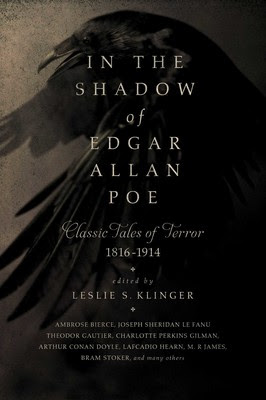
My twice-monthly library writer's group met in my home library this week as our usual library meeting room is being refurbished. During a long discussion about short story structure, I mentioned Leslie Klinger's excellent anthology, In The Shadow of Edgar Allan Poe: Classic Tales of Horror, 1816-1914, and one of the short stories included in it that is so well written I can't get it out of my mind weeks later.

In the spirit of full disclosure, that is not exactly what happened. I told the group that I read the unforgettable story, "The Spider" in a wonderful anthology. I could not remember exactly which anthology nor the editor or author name at the moment. But I could remember "The Spider." Google was not much use. "The Spider" brought up many, many hits and pages and not one immediately right.

The story has it all: structure, tension, wry humor, a very surprising ending. And now it lives, as the saying goes, "rent free in my brain." After being embarrassed by my on-the-spot failure to remember which book, editor or author, I followed up with an email to the group once my head finally cooperated and I found the right information. 

(You know, the right information right there in my Books Read 2023 spreadsheet that I fumbled around with for ten minutes at the meeting and yet never saw the correct entry.) Once I sorted it out, I thought I would not forget any of the three again. Well, I was wrong as the author's name has already left my thinking as I sit here typing only forty-eight hours later. (Hanns Heinz Ewers)  If you haven't read it, treat yourself to the book and specifically the story.

My brain wasn't finished with me quite yet. One person asked me if Doyle had a short story in the anthology. I remembered that he did. I did not immediately remember which one. My brain then helpfully said, "Lot No.249." As I said it, I realized I do not remember the details of Doyle's mummy story like I remember the details of "The Spider." I thought about that for awhile and I think the forgetting is because of the mummy movies I've seen over and over so many times. The over saturation has stolen from me the joy of discovering and rediscovering Doyle's story. His first readers must have felt about "Lot No.249" like I feel about the surprising spider. I decided I might want to reread Klinger's book and see how I would compare all the stories to "The Spider" and to "Lot No.249."

Except--you've already guessed it--"Lot No.249" is not in the Klinger anthology with "The Spider." The wise Mr. Klinger chose Doyle's  excellent "The Leather Funnel" for the book. I'm going to read "Lot No.249" again anyway. And "The Leather Funnel" and a stack more of them before all is done. 

I've decided to forgive my brain because, hey, even Sherlock Holmes had his days. You might remember in The Sign of the Four, after Holmes and Watson find the small footprint at the murder scene, Watson reports this about Holmes: "I was staggered for the moment," he said, "but the thing is quite natural. My memory failed me, or I should have been able to foretell it. There is nothing more to be learned here."

There is a little more to be remembered here. During my weeks of non-Doyle reading, I discovered two other new-to-me short stories my brain has kindly let me remember and reconsider often:  "DĂ©sirĂ©e's Baby" by Kate Chopin and "The Cross-Roads" by Amy Lowell. They, too, are worth a little rent free space.


Wednesday, August 16, 2023

ADMIRING THE BEGINNINGS


A wild-eyed and frantic young man burst into the room.

 After taking June and July away from  the world of Arthur Conan Doyle (except for a little work for the Blue John Gap Project), I'm enjoying finding my way back in August. The first two weeks I spent on the JHWS Treasure Hunt. It was good fun to poke around in the Sherlockian Canon with my team members, finding old bits I remember well and some I had forgotten. In that process I was reminded how skilled Doyle was at crafting interesting story openings, including the arrival of the "unhappy John Hector McFarlane" above. 

His skill with openings certainly extends out of the Sherlockian Canon and into his other work. More than once, I've stopped reading a story in order to reread the opening paragraphs and admire how Doyle crafted a scene. He used a deft touch to show the reader what the people in the story were like. I'm fascinated by how effortless he makes it seem.  Two of my favorites, oddly enough, come from Doyle writing about photography. 

The first, After Cormorants with a Camera, begins:

It was about the end of July that my old friend "Chawles" dropped in upon me in Edinburgh. We always called him "Chawles" though no one could ever tell why, as his name is Thomas. Unshackled by a profession, and a keen shot, he is endeavouring to vary the humdrum monotony of ordinary sport, either by the discovery of some fresh game or by devising new means of circumventing the old. He disclosed his latest project amid clouds of tobacco smoke:- "The Isle of May, my boy! That's the place for this year! None of your tame rabbits and semi-civilised pheasants over there; but fine, old, pre-Adamite cormorants 'with a most ancient and fish-like smell.' That's where a fellow can knock the cobwebs out of him, Bob! By the way, old man," he continued, glancing at my camera and batch of printing-frames cooking in the sunshine, "why not come along? It's the very place for you. Think of the old black cliffs, the caves, the basalt, and all that sort of thing. Bring your filthy paraphernalia along with you. Start on Wednesday and we shall be back by Saturday night. Why not? Say 'yes' and it's a fixture."

Why not, indeed? The University session was over, my friends out of town, Princes-street a howling wilderness, and I in need of a change. The Isle of May seemed to offer "fresh fields and pastures new" both for myself and to my camera.

"Well, 'Chawles,' " I said, "if you won't drink my cyanide or 'fiddle' with my plate-carriers, and will promise to conduct yourself generally like a respectable christian, I'm your man."

"Done with you!" said "Chawles," reaching over his hand to ratify the bargain. "That is a fixture then."

"Couldn't we get another fellow?" said I. "We'd have room to quarrel then." Who could we get! This was a question easier to ask than to answer. There was Singleton, but he didn't drink; there was Jack Hawkins, but he drank too much; then there was Holmes, but he neither smoked nor drank; while Godfrey's continual wails about his pipe were fatal to peace and quietness. Who should it be? "Happy thought!" said I. "Who d'ye think I met in town today? The Doctor! He is our man!"

When I first became aware of this story, I read the opening several times before I finished the rest of it. Doyle makes me want to go on the trip, and I already like Chawles and, of course, I like the doctor. In Doyle's world, the doctor usually is our man. And what an astute assessment of human nature: "Couldn't we get another fellow?" said I. "We'd have room to quarrel then." It is always good for a group of people to have some room to quarrel, just in case. At this very moment, I don't remember the rest of the story although I've read it at least twice. But this beginning? I know it and it makes me laugh every time I read it.

The second, Dry Plates on a Wet Moor, begins:

My esteemed friend, whom I shall call the "Commodore," as he is known to a small circle under that sobriquet, is a man who is always toiling painfully along some twenty years in the rear of the main body of the human family. I am sure he will not take umbrage at my remark, but rather be the first to acknowledge its truth. Railways and telegraphs have gradually begun to overcome the vis inertice of the Commodore's mind and to obtrude themselves as undeniable facts, but that is apparently the last concession which he will allow to progress, and he fiercely resents any allusion to telephones, electric lights, and other departures from the ways of our ancestors. He has the courage of his convictions, too, as is to be seen by the shares in which he eagerly invests, having at last made up his mind that, as a lighting power, coal gas is preferable to oil. This being the character of the man, it is not surprising that as a photographer he is an ardent supporter of collodion, and revels in every process which the rest of the fraternity have agreed to abandon. There is something majestic in his conservative scorn for improvement, and he looks upon a gelatine-bromide plate very much as a chevalier of the old regime might have gazed upon a bonnet rouge of the republic. Still, those who have seen the Commodore's results will allow that he has something to justify him in his opinions, and that skillful manipulation is independent of any process.

When the Commodore strode into my apartment in the middle of August, and interrupted me in retouching a batch of plates, I knew that something was up. He is not a demonstrative man; on the contrary, his emotions are all deeply seated and seldom show upon the surface, but it was evident that he was in high spirits and bursting with some piece of information. I mischievously left him to simmer for some time upon a chair, while I finished my retouching.

"Well, Commodore," I said at last, "what is it?"

The murder was soon out. The office were to have a holiday after their ten months servitude at the desk — only for three days, it is true but still a holiday. The Commodore had been brushing up his fossil apparatus, and was bent upon a short campaign among the wilds. He had come up to know if I would accompany him. Dartmoor was to be the destination, and the train started within an hour and a half.

Don't we all have a friend like this? The one we might affectionately call a Luddite with a shake of our head. I was immediately intrigued by the Commodore's sobriquet. Obviously, he is not really a military man. A three-day holiday on the moor--what could possibly go wrong?  For those of us that read Sherlock Holmes, we know a lot can go wrong on the moor. This opening drew me right in.

I'll be ready soon to start a new manuscript having to do with Doyle's Round the Fire stories. I won't forget what he has taught me about how to set a stage for a reader. As Holmes tells Watson in "The Adventure of the Norwood Builder" once Lestrade and the unhappy McFarlane depart, "... But it is evident to me that the logical way to approach the case is to begin by trying to throw some light upon the first..."; I will try to do the same.

Monday, July 24, 2023

"BUT THAT FELLOW DOES PUZZLE ME."


"An instant later the tutor returned, bringing with him the student."

Well, it is not exactly in an instant, but the tutor, otherwise known as the clever and funny Rich Krisciunas, has announced he is serving as the John H Watson Society Treasure Hunt master again this August; therefore, the student, me, is coming right along to see what craftiness he has planned for this year's hunt. He always teaches me something I didn't know about the Sherlock Holmes Canon, and invariably does so in an engaging and pleasant way. His quiz-ending ciphers are mind-boggling for a few of us. Rich turns up everywhere--what a gift he is to the Sherlockian community, and especially to the small but loyal Treasure Hunt community.


As I've mentioned before, the first JHWS "Buttons" Don Libey was a dear friend to me, and I've been a supporter of the Treasure Hunt since he created it in 2013. Don was a smart and funny and kind man who managed to accomplish a lot of work.  Rich seems very much like him. I think the two would have liked one another. I'm certainly grateful to have had a friendship with Don, and I'm very grateful to now be friends with Rich. 

I'm not sure my Sherlockian world would have ever grown far from my home group of The Sound of the Baskervilles if it had not been for Don and those early Treasure Hunts. I'm not sure if the SOBs will have a team competing this year but I'm hopeful. I'm also hopeful some of the TH stalwarts return, including Michael Ellis, Steve Mason, Paul Thomas Miller and Brad Keefauver, among others.

Rich posted five warm-up questions this past week. I spent a little time working on them over the weekend.  I enjoyed the process. I've put my answers below; I think they are correct. Only #5 gives me a little worry; the TH style wording makes me think I might have missed something as my answer seems mostly on point but doesn't feel 100% on point.   

Maybe someone will review my answers and let me know how I did.

-----------------------------------------------------------------------------------

1. What object did Watson see on top of a bookcase?

Answer: Bust of Athene

Opposite was a large bookcase, with a marble burst of Athene on the top. --"The Adventure of Charles Augustus Milverton"

2. Who besides the King of Bohemia had the chest and limbs of a Hercules?

Answer: The pretend Russian Nobleman's companion who visited Dr. Percy Trevelyan

He was an elderly man, thin, demure, and commonplace-by no means the conception one forms of a Russian nobleman.  I was much more struck by the appearance of his companion.  This was a tall young man, surprisingly handsome, with a dark, fierce face, and the limbs and chest of a Hercules. --"The Adventure of the Resident Patient"

3. A store selling maps had the same name as a man arrested by Watson. 

Answer: Stamford's and Stamford

 As Annotated at  The Arthur-Conan-Doyle Encyclopedia: 

«After you left I sent down to Stamford's for the Ordnance map of this portion of the moor, and my spirit has hovered over it all day. »--The Hound of the Baskervilles

«'Stamford's' in the Strand and American versions. The real name was Edward Stanford's, map sellers, 26 Cockspur Street, Charing Cross.»

You remember, Watson, that it was near there that we took Archie Stamford, the forger. --"The Adventure of the Solitary Cyclist"

4. What was the make of the car driven by Watson?

 Answer: Ford

The secretary lay back in the cushions of the luxurious limousine, with his thoughts so full of the impending European tragedy that he hardly observed that as his car swung round the village street it nearly passed over a little Ford coming in the opposite direction.

He was just in time to see the lights of a small car come to a halt at the gate.  A passenger sprang out and advanced swiftly towards him, while the chauffeur, a heavily built, elderly man, with a grey moustache, settled down, like one who resigns himself to a long vigil.

The thick-set chauffeur, who had seated himself by the table, pushed forward his glass with some eagerness. 'It is a good wine, Holmes.' 'A remarkable wine, Watson.'-- "His Last Bow"

5. He taught him how to convert stolen property into money.

Answer: Maudsley taught James Ryder

I had a friend once called Maudsley, who went to the bad, and has just been serving his time in Pentonville. One day he had met me, and fell into talk about the ways of thieves and how they could get rid of what they stole. I knew that he would be true to me, for I knew one or two things about him, so I made up my mind to go right on to Kilburn, where he lived, and take him into my confidence. He would show me how to turn the stone into money. -- "The Adventure of the Blue Carbuncle"

Friday, July 7, 2023

A FEW WORDS MAY SUFFICE

Sir Arthur Conan Doyle


22 May 1859 - 7 July 1930

As I had my customary toast to Arthur Conan Doyle today in remembrance of his death ninety-three years ago, I did the silly thing that I often do on July 7: I compared what I am doing to what he was doing at my age. The good Sir Arthur and I were born 100 years (plus a couple of months) apart so my knowing his age at a point in time is fairly easy math for me.  He was 64 years old in July 1923 and in the last decade of his life. (I think about that, too, hoping that this is not my last decade.)

As always, anything I'm doing pales in comparison to what he was doing at my age. He spent that last decade doing what he always did: writing, campaigning on someone's behalf and carrying the Spiritualist message to the world. If I remember correctly he traveled in America in 2023. His life is so often a blur when I try to remember beyond his early years. He always did so much. Even when I can't agree with what he did I'm still in awe of his ability to be so alive, so involved, and so caring in many ways.

I do not say he is "the best and the wisest man whom I have ever known" but he is on my list. I'm grateful to spend part of my life engrossed in his life and work.

------------------------------------------------------------------------------------

[When I first tried writing fiction about Doyle, I made a little playlet about the day Arthur Conan Doyle died for a book for Doyle's Rotary Coffin. I've attached it below.]


SOME COMMON THREAD

A play in one scene

CHARACTERS

PHINEAS— Lilliputian-sized elfin creature. Very formally dressed. Fussily and excessively respectable.

ALVISS—Lilliputian-sized elfin creature. Dressed in pajamas. Bemused and emotive.

SETTING/TIME

A comfortable tiny sitting room situated inside a mouse hole in the attic of Windlesham Manor, Crowborough, East Sussex. Afternoon tea-time.  July 7, 1930                                                              

SCENE ONE

(ALVISS is sitting in an easy chair, in pajamas and robe, with a glass of wine. A carafe sits on an ottoman to his right. PHINEAS enters the room, with notes and pencil in hand, drops a small bag by the door.)

ALVISS:  I thought you were never coming back. Tea-time is a good half hour gone. I started without you.

PHINEAS: Tea? Looks more like Tokay. The time got away from me.  There is so much activity in the house. I needed to take notes.

ALVISS: Yes, Tokay. Seemed appropriate.  As our friend said. (Lifts the glass in a mock toast and continues in an exaggerated stage voice.) “’Another glass, Watson,’ said Mr. Sherlock Holmes as he extended the bottle of Imperial Tokay.”  (Sips at his wine and then sighs heavily.)  Why the notes? The gent is dead. Therefore, Holmes and all the others are dead. Makes me wish I had helped him with his ridiculous British Campaign in France and Flanders.

PHINEAS: (Removes nonexistent lint from his coat, sits in the other easy chair, smooths his trousers, and accepts a glass of wine from ALVISS.)

Your Brobdingnagian-sized efforts with The Great Boer War, and, indeed, with Holmes himself, earned you the right of a Lilliputian-sized effort with that hopeless Flanders debacle.

ALVISS: Oh, Phineas.  You always come back to Swift.  Always.  (Lifts the glass in a mock toast again.) I can’t hold it against you. It was a good run with Swift.  We were inspired with that one.  One of the highlights of our long career.  (He sighs heavily again.) The gent is dead. I know he never rose to the revered strata of some of our more…um…shall we say illustrious clients…but he has been good fun to work with. And we’ve been very comfortable here these few years, especially since we moved from the hut to the house.  I was cold every seemingly endless day we toiled with Chaucer.

PHINEAS: (Laughs in the noiseless fashion peculiar to him.) I hated the distempered red paint in the hut.  Why did he want to write there? And, yes, Chaucer: travel, travel, travel.  We had a bit of fun with him at that wedding listening to the Petrarch fellow.  It is a shame we were never assigned to him. I simply couldn’t resist adding him to Holmes’s pocket.

ALVISS: (Stands, holds up an imaginary book, speaks in a deep, slightly mocking theatrical voice.) “No, sir, I shall approach this case from the point of view that what this young man says is true, and we shall see whither that hypothesis will lead us.  And now here is my pocket Petrarch, and not another word shall I say of this case until we are on the scene of action.”

PHINEAS: (Laughs again.) How do you remember all the text?  What is that, Boscombe Valley? Our little Adventures certainly changed the gent’s life.  Despite his prodigious output, he needed income. Working with an underfunded client is so vexing. (Goes to the door and brings the bag to the ottoman.) Here, I’ve brought some brown bread and butter.  I tried for something more but the infernal dog interfered.  Dogs! They always know we are here.  I enjoyed suggesting ways for the gent to knock them off: poison, a stinging jellyfish, dispatching by gun fire.  Those were delicious, as I hope this bread will be.

(They take some bread each, refill their glasses, and sit in the armchairs.)  

ALVISS: You really shouldn’t be too hard on old Paddy.  Despite being the girl’s dog, he is fond of the gent.  The dog will be sad. He hasn’t chased us in years, and he rarely disturbs us here. Remember that awful Crab in Shakespeare’s company. (Shudders.) The old bard has certainly become our most illustrious and long read client to date.  I hardly expected it.  I wonder if any of the gent’s works will survive the test of human time and imagination.  I suspect Holmes might.  He is, apparently, much admired. This bread is good. I wonder what we will eat with the new host.

(Each stare wistfully into space, chewing silently, lost in thought.)

PHINEAS: Wherever we go, I hope the host is as receptive as the gent.  I’ve become quite accustomed to having my ideas accepted without question as his own.  I never want another one like that Bulwer-Lytton—he wouldn’t listen to anything. Remember his “It was a dark and stormy night; the rain fell in torrents—” and onto the other forty-six words of that ridiculous opening sentence. (Voice rises stridently.)  The only time we’ve ever had to leave early. Our history is storied—if you’ll pardon the pun—and there we were. Out! The first time in a thousand years of work as humans measure it. Shameful.   

ALVISS: Phineas, please. Let’s not go over it again.  I wouldn’t be surprised if the name of our new host arrives today.  It seldom takes long for the light to appear. Let’s hope we get to stay in the British Isles.  Can you imagine if we had to go to America?

PHINEAS: No, no, no.  I wouldn’t stand for it. (Sniffs.) They hardly have the history or talent for the likes of us.

ALVISS: I don’t know. I can’t imagine it.  Did you hear anything interesting when you were out today?

PHINEAS: Oh, yes! (Gathers his notes.)  His last words were to the lady, of course.  He said, “You are wonderful.” He did love the lady. I immediately thought we should construct a proper death for Holmes—not that silly thing the gent did when we were feverish—but a proper send off.  I can hear him saying those exact words to Watson.   Can you imagine it?

ALVISS: Yes, I can.  Our Dr. Watson.  I’m going to miss him too. 

(A ray of light suddenly appears in the room, exploding into tiny stars which then meld into one floating piece of parchment.  PHINEAS and ALVISS stand, take a deep breath.)

PHINEAS: It is here! Now! Already!  Hurry! Read it!

ALVISS: Yes, yes. Oh, where are my glasses?! (ALVISS fumbles with a pince nez for a few seconds, finally resting it on his face.)  I have it.  I don’t know exactly how to say this name.  I will spell it for you:  T-O-L-K-I-E-N.

THE END


Wednesday, June 21, 2023

SMOKING AND DREAMING


During this time Holmes spent some of his time smoking and dreaming in the cottage, but a greater portion in country walks which he undertook alone, returning after many hours without remark as to where he had been. ----- "The Adventure of the Devil's Foot"

Like many people of my generation, I gave up smoking years ago. However, every now and again, I find myself tempted to smoke. Not because I have a physical craving for nicotine but because, like Holmes, I found that my imaginative thinking for problem solving seemed to work better as I sat (actually stood outside) and smoked. There was something about smoking that eased the deliberate act of choosing to stand still and creatively think. Perhaps it was about having something to do with my hands while my thoughts agitated. Perhaps it was about being confined to the smoking spot while my mind went out and abroad to wherever it wanted to go. 

Don't get me wrong. I hated everything about smoking (the smell, the mess, the bother, the cost, the sheer danger of it) except...well, smoking. I liked how my brain seemed to work and I liked the stress relief aspect of it. I was fortunate to never become a heavy smoker and when I decided to quit, I just did with very little fuss or bother. As I said, fortunate, especially considering all the bad that smoking can entail. But, still, I certainly understand Holmes's smoking-in-order-to-think processes.

Better Sherlockians than I am have written extensively about Holmes and his smoking and I certainly have nothing of any great importance to add to the body of work. Sometimes I think we gloss over how actually awful that much smoking must have been. We have fun talking about a "three-pipe problem" and being grossed out by Holmes's habit of a before-breakfast pipe composed of "all the plugs and dottles left from his smokes of the day before."  We never forget how much smoking he did in order to solve the problem of "The Man with the Twisted Lip":

He took off his coat and waistcoat, put on a large blue dressing-gown, and then wandered about the room collecting pillows from his bed, and cushions from the sofa and armchairs. With these he constructed a sort of Eastern divan, upon which he perched himself cross-legged, with an ounce of shag -tobacco and a box of matches laid out in front of him. In the dim light of the lamp I saw him sitting there, an old brier pipe between his lips, his eyes fixed vacantly upon the corner of the ceiling, the blue smoke curling up from him, silent, motionless, with the light shining upon his strong-set aquiline features.

And of course Watson was right there smoking with him. At this moment, I can't remember if Watson ever said he believed smoking helped him think and I'm too lazy to find out. I doubt it, though. Watson probably smoked because almost everyone smoked. Those rooms in Baker Street were probably a yellow mess that was not at all like the romantic "A yellow fog swirls past the window-pane As night descends upon this fabled street..."

Over the past three years as I've struggled to learn to write fiction I missed the smoking-thinking  more than ever. The only substitute I found for the the process was baking, especially bread. Kneading works almost as well as far as the hands busy and standing in a specific space aspects of the smoking. A few months ago I was having trouble nailing the opening of a story. I had written it at least a half dozen times and nothing seemed right.

I took a break to bake some pecan sticky buns--a good dough recipe that required some serious kneading. As I worked the dough my mind started to wander. For no specific reason this bit from Arthur Conan Doyle's "After Cormorants with a Camera" came to mind:

I had two stands — one a short ash tripod, the other an invention of my own, which I have found of great service in working the moorlands of Scotland. It simply consists of a stout walking-staff four feet long and shod with iron. This is fitted to the camera by means of an adjustable ball-and-socket joint. The advantages which I claim for this simple arrangement are not only its lightness (a consideration which will have weight with every practical worker in the open air) but also its cheapness, and the facility it affords for the focusing of a moving object. By it free movement is secured in every direction, both horizontal and vertical, while four inches of iron spike are sufficient to guarantee perfect steadiness.

There was something about that walking stick that gave me not only the opening to the story but the emotional make up of my lead character who carried it. He was a man who proved to be able to move in every direction as needed but to stay perfectly steady in himself. The opening of "Among The Ruins" eventually came to read like this:

I watched the dawn break above as I set out from Sparwick towards the ruins of the ancient Payneven manor house. I followed the footpath along the Windrush with the aid of my stout walking-staff, four feet long and shod with iron—an invention of a colleague of mine, the articulate one in South Norwood with photography as a hobby. He intended it as a camera stand, the camera fitted by means of an adjustable ball-and-socket joint, but I found it perfectly balanced for rough ground walking along the river.

Our poor fellow faced rough ground in many different ways along the river but that is a story for another day. 

I've lightened up on the baking in the last six months as the household was putting on a little too much weight. The bulk of the kneading had to stop. I've found lighter recipes that work best with hand mixing and that kinda works. It is not as effective as the kneading or the smoking but needs must.

I'll never go back to smoking like Holmes but I certainly hope that someday I get to go to Cornwall to take hours long country walks by myself like he did.  I have a Sherlockian friend who was able  to walk like Holmes in Cornwall for a week but that, too, is a story for another day.


Saturday, June 10, 2023

Choosing From Among The Best

Arthur Conan Doyle & The Stark Munro Letters

(The Salt Lake Herald, Nov 3, 1894) 


When Mattias Boström posted the above on Twitter this morning I had to laugh. I read it immediately following a conversation I had concerning this very topic: Is The Stark Munro Letters Doyle's best work? I don't know that I can unequivocally say yes because I haven't read all his work and I'm hardly qualified to make such a broad statement. I am willing to say that of the work I have read, Stark Munro is rapidly becoming my favorite of the lot. The Hound of the Baskervilles was once at the top of my Doyle rereading list. Now it is second on the list. Given a choice, I prefer to read Stark Munro again.

Stark Munro as my favorite Doyle book in no way diminishes my fondness for Sherlock Holmes; he is the foundation of my Sherlockian life, which is a living thing that goes far beyond the texts of a few books. When deep in the texts, though, Stark Munro shines for me.

A look at my working copy of the book (as always, I have one to abuse and one to save) certainly indicates I find value in it:


I have a tendency to put flags in books marking points I wish to remember. I thumb through the books and read around the markers for inspiration when I'm writing. This book gets a lot of attention from me because J. Stark Munro is trying to understand his place in the day-by-day, scratch-out-a-living world and his place in the vastness of the universe. He thinks it is important to understand each place. I do, too.

    My first flag is at the point where J. Stark Munro declares he is all of twenty two years old and

"...in all seriousness, without a touch of levity, and from the bottom of my soul, I assure you that I have at the present moment the very vaguest idea as to whence I have come from, whither I am going, or what I am here for. It is not for want of inquiry, or from indifference."

I am much older that twenty-two but I can only say "Me, too, Johnnie Munro, me, too."  I want the characters I write (outside the confines of the traditional Holmes/Watson pastiche) to have the very vaguest idea as well so that I might give their words and actions a ring of truth readers recognize.

Doyle's prose flows easily in this book. He writes with a deft touch, alternating between the young doctor's daily struggle to make ends meet and his larger struggle to define his faith or lack thereof. J. Stark Munro is a generous, caring man with a wry sense of humor. I would like to have him over for dinner.  

He is very much like Dr. John H. Watson except I think Watson isn't quite so introspective. I'm not sure Watson would have patience for all of Stark Munro's musings. Actually, I would like to have them both to dinner and find out. I have a place for each of them at my table and in my heart.


Tuesday, May 30, 2023

MY HEAD WHIRLS


Percy Phelps sank back in his chair.
'My head whirls,' said he; 'your words have dazed me.'

One day this past week I found myself identifying somewhat with the ridiculous Percy Phelps and his experience of receiving a thought changing surprise over breakfast. (OK, it might be a bit of a stretch, but humor me.) Dawdling over breakfast, the newspaper and Wordle done, I opened Twitter, and found this post, with photos from the Baker Street Journal, Volume 2, Number 4, 1947:

A charming short story written by Basil Rathbone in this 1947 issue of The Baker Street Journal titled “Daydream”. He imagines an accidental meeting with Sherlock Holmes following a sting from one of his bees whilst on holiday in Sussex #sherlockholmes


I immediately pulled the Journal from the shelf and read the story. The piece is delightful--beautifully written and imaginative. I was stunned. I suddenly needed to think about Basil Rathbone in a different light.

In the spirit of full disclosure, I've never thought very much about Basil Rathbone at all. I did not grow up watching his Sherlock Holmes movies on television and I've never watched them through to this date. I have trouble keeping track of which parts I've seen and which movie is which. Nigel Bruce as Watson always annoyed me so I mostly stayed away. (Although, as I've aged, I've started to see the charm of the films, including Bruce's portrayal.) The only real time I've given to Rathbone was while reading the parts about him within Mattias Bostrom's From Holmes to Sherlock. 

In my mind, Rathbone was probably a nice man and excellent actor who saw his career stunted by being typecast as Holmes. I filed him away as such in the brain attic and didn't pay much attention otherwise. After reading his "Daydream," I realized I needed to reconsider the man and the variety of his work. What else did he write that I should have read?

I felt somewhat better about my lack of awareness when I saw that several Sherlockians I admire made posts on Twitter about being unaware of Rathbone and "Daydream."  In the course of reading through some of the replies and comments, I saw this post from David Stuart Davies:

David Stuart Davies
I have it - but the fascinating thing is, Basil had just left the film and radio series because he was fed up playing the character and then writes this piece.

The emotional distance between the quitting of the work and the writing of the story is fascinating, too. Certainly he had an emotional connection to Holmes. I started creating symbolism into the dialogue of the story where perhaps none existed. Did the stinging bee--that died after stinging the narrator--represent Rathbone's experience playing Holmes?

"I'm sorry to see that you have been stung by one of my bees."
I smiled; the smile was intended to say that it didn't matter.
"You must forgive the little fellow," he continued. "He's paid for it with his life."
"It seems unfair that he should have had to," I said, hearing my own voice as if it had been someone else's.

It seems unfair that he should have had to. Hearing my own voice as if it had been some one else's. 

Yes, Mr. Rathbone, it is unfair that you should have had to endure what happened to your career and your ability to use your own voice. Your celebrity as Holmes came at a high price.

I do not know if he meant "Daydream" to say that the price didn't matter but I wonder, especially when reading this part that soon follows the conversation above:

The incident--for an incident it had become--was strangely tempered with magic.

Sherlockians know that Holmes's world is sometimes tempered with unexpected magic. Did Rathbone agree? As always, the only way for me to know is to read. And I will. 

I understand he penned an autobiography. I expect to start reading it after breakfast one day soon.