Saturday, October 14, 2023

LET US GLANCE AT OUR GAZETTEER #2


Over the course of this year, I've written four short essays about Arthur Conan Doyle for inclusion in the Sherlock's Spotlight Gazette published by The Beacon Society for young readers. As I finished work on the final essay for 2023, I decided to post the four to this site. Here is the second, where I hoped to show the young readers how one unexpected opportunity can change everything. 


About Arthur, the Author

Glimpses into the life of Sir Arthur Conan Doyle, creator of Sherlock Holmes


From Experience to Inspiration

Fiction writers often draw on their life experiences to inspire their stories and Arthur Conan Doyle was no exception. He lived a very adventurous life, traveling to most parts of the world, experiencing many different cultures and climates. He dined with kings, worked in military hospitals, spoke to vast audiences, played numerous sports, learned musical instruments, investigated crimes, reported from the front lines of war, and so much more. One of his earliest adventures inspired several of his sea-going stories, including one considered by many people to be one of his very best, “The Captain of the Polestar” and a notable series of exciting tales about a brutal pirate named Captain Sharkey.


              In February of 1880, twenty-year-old Arthur Conan Doyle was in his third year of medical school. He needed money to continue his studies, so he signed on as a crew doctor for the whaling ship, Hope. Although Arthur was not a full-fledged doctor yet, he had enough training to join the crew for the expedition. Captain John Gray gave him the job when Arthur’s friend Currie, a fellow medical student, changed his mind about taking the position. The Hope was to spend seven months in the Arctic Ocean.


The Arctic Ocean includes the North Pole region of the northern hemisphere. Its borders include the Bering Strait on the Pacific side and the Greenland Scotland Ridge on the Atlantic side. The ocean was covered by sea ice throughout the year and it was very dangerous for ships and the sailors. The Hope sailed from Peterhead, a town in Aberdeen, Scotland. But it immediately ran into foul weather. The captain managed to find a safe place in a harbor in the Shetland Islands just before the full force of a hurricane could cripple the ship. They could not leave for the arctic until March.


              Only four days later, Arthur awoke to the sound of floating ice pieces bumping into the sides of the boat. It appeared the entire sea was covered with drifting ice. “They were none of them large,” he wrote later, “but they lay so thick that a man might travel far by springing from one to another.”

              The ship’s crew intended to hunt for seals. Arthur hoped to go with the crew out onto the ice but because a strong swell had risen, the floating ice pieces were crashing into one another. The ship’s captain told Arthur he had to stay on the ship as he did not have enough experience to safely walk about on the moving ice and would surely fall into the dangerously cold sea.


              A disappointed and angry Arthur obeyed the captain and went to sit on top of the bulwarks of the ship with his legs dangling over the side. He did not realize a sheet of ice had formed on the bulwark and in just a moment, he slid off the ship and vanished into the sea between two ice blocks. Luckily he crawled onto one of the blocks and managed to get back onto the ship. 


              As he had already fallen, the captain then allowed him to come out onto the ice with the crew, saying Arthur “was bound to fall into the ocean in any case and might as well be on the ice.”  The captain was right. Arthur tumbled into the dangerous water two more times that day. He had to return to the ship and go to bed while his clothes were thawed and dried out in the engine room.

              He went on to have other dangerous days on the ice.  There were other surprises during the voyage including a chance to see a right whale (baleen) jumping completely out of the water into the air. Arthur was fascinated by the animal life that lived in such a stark and unforgiving atmosphere:


The perpetual light, the glare of the white ice, the deep blue of the water, these are the things which one remembers most clearly... the innumerable sea-birds, whose call is for ever ringing in your ears—the gulls, the fulmars, the snow-birds, the burgomasters, the looms, and the rotjes.These fill the air, and below, the waters are for ever giving you a peep of some strange new creature...the mis-shapen hunchback whale, the ghost-like white whale, the narwhal, with his unicorn horn, the queer-looking bottle-nose, the huge, sluggish, Greenland shark, and the terrible killing grampus, the most formidable of all the monsters of the deep,—these are the creatures who own those unsailed seas.

On the ice are the seals, the saddle-backs, the ground seals and the huge bladdernoses, 12 feet from nose to tail, with the power of blowing up a great blood-red football upon their noses when they are angry, which they usually are. Occasionally one sees a white Arctic fox upon the ice, and everywhere are the bears.

              After many months at sea, he finally returned home to Scotland and his medical studies. But his life had changed. The isolation, the danger, and the unusual life on the ship altered his thinking, his health, and his understanding of the world around him. He said the Arctic had awakened “the soul of a born wanderer.”


Tuesday, October 3, 2023

LET US GLANCE AT OUR GAZETTEER

Over the course of this year, I've written three short essays about Arthur Conan Doyle for inclusion in the Sherlock's Spotlight Gazette published by The Beacon Society for young readers. As I begin work on the final essay for this 2023, I decided to post the previous three to this site, beginning with, appropriately, "The Beginnings of a Storyteller."

About Arthur, the Author

Glimpses into the life of Sir Arthur Conan Doyle, creator of Sherlock Holmes

The Beginnings of a Storyteller

Arthur Conan Doyle, creator of Sherlock Holmes and Dr. Watson, first wrote a mystery about them in 1886. He was twenty-seven years old. He authored many stories and created many characters before Holmes and Watson. His storytelling actually began when he was a young boy living in a boarding school.

              At the age of nine, he left his family in Scotland, traveling by train alone, to live in England at a school called Hodder. He lived at Hodder for two years, and then moved to a nearby school for older boys called Stonyhurst, for another five years. During those seven years, he only saw his family during summer break. The school did not have other breaks during the year. Except for the six-week vacation in the summer, the boys never went home.

              He was sometimes lonely, but he discovered that he had what he called “some literary streak” that was not common to the other boys in his school. He created stories about heroes and their adventures, which he shared. The other students were thrilled by Arthur’s storytelling.

              An audience of young boys would sit on the floor, their chins on their hands, and listen as Arthur, standing on a desk before them, would tell stories until his voice grew husky. Remember: the school had no televisions, no computers, no internet, and no telephones. For them, the story time with Arthur was like going to a movie.

              He learned to tell a story in an entertaining way from his mother. Mary Doyle loved to read, and she had a natural gift for telling Arthur and his brother and sisters thrilling tales about the characters in the books she read. “In my early childhood, as far back as I can remember anything at all,” he wrote many years later, “the vivid stories which she would tell me stand out so clearly that they obscure the real facts of my life.”

              During the summer holidays, he would read many books he borrowed from the small library near his home. He read so many so quickly that the librarians had to tell his mother that Arthur was limited to exchanging books only twice a day! When he went back to school, he had many more adventure stories he could share. The reading inspired him to create his own stories for his school friends.

              Arthur’s storytelling gave him an added bonus: treats! His schoolmates enjoyed his stories so much they would at times bribe Arthur to keep talking by giving him pastries or apples. The students ate very plain meals. For breakfast, they had a bit of dry bread and hot watered milk. For lunch (they called it dinner), there was a little beef and fish on Fridays. For a snack in the afternoon, they had dry bread again with an odd brown drink that was called “beer” because of its color, but it was not really beer. For supper, they had hot milk again, bread, butter, and sometimes potatoes. A treat such as a pastry or an apple was rare and special. The boys found his stories to be worth the price.

              Arthur Conan Doyle was on his way to becoming the storyteller who would later entertain millions of people.

Wednesday, August 30, 2023

MY MIND REBELS

Sherlock Holmes famously told Dr. Watson "My mind rebels at stagnation. Give me problems, give me work, give me the most abstruse cryptogram, or the most intricate analysis, and I am in my own proper atmosphere." Lucky Holmes. I have found that my mind tends to rebel against its proper function at times and seemingly enjoys a nice long period of stagnation. I've been struggling to get back in to a pattern of studying and writing everyday after taking a couple of months away. Not only has my mind failed to fully cooperate, it has taken me on several unnecessary side excursions. A good example:

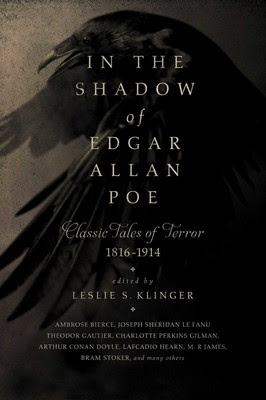
My twice-monthly library writer's group met in my home library this week as our usual library meeting room is being refurbished. During a long discussion about short story structure, I mentioned Leslie Klinger's excellent anthology, In The Shadow of Edgar Allan Poe: Classic Tales of Horror, 1816-1914, and one of the short stories included in it that is so well written I can't get it out of my mind weeks later.

In the spirit of full disclosure, that is not exactly what happened. I told the group that I read the unforgettable story, "The Spider" in a wonderful anthology. I could not remember exactly which anthology nor the editor or author name at the moment. But I could remember "The Spider." Google was not much use. "The Spider" brought up many, many hits and pages and not one immediately right.

The story has it all: structure, tension, wry humor, a very surprising ending. And now it lives, as the saying goes, "rent free in my brain." After being embarrassed by my on-the-spot failure to remember which book, editor or author, I followed up with an email to the group once my head finally cooperated and I found the right information. 

(You know, the right information right there in my Books Read 2023 spreadsheet that I fumbled around with for ten minutes at the meeting and yet never saw the correct entry.) Once I sorted it out, I thought I would not forget any of the three again. Well, I was wrong as the author's name has already left my thinking as I sit here typing only forty-eight hours later. (Hanns Heinz Ewers)  If you haven't read it, treat yourself to the book and specifically the story.

My brain wasn't finished with me quite yet. One person asked me if Doyle had a short story in the anthology. I remembered that he did. I did not immediately remember which one. My brain then helpfully said, "Lot No.249." As I said it, I realized I do not remember the details of Doyle's mummy story like I remember the details of "The Spider." I thought about that for awhile and I think the forgetting is because of the mummy movies I've seen over and over so many times. The over saturation has stolen from me the joy of discovering and rediscovering Doyle's story. His first readers must have felt about "Lot No.249" like I feel about the surprising spider. I decided I might want to reread Klinger's book and see how I would compare all the stories to "The Spider" and to "Lot No.249."

Except--you've already guessed it--"Lot No.249" is not in the Klinger anthology with "The Spider." The wise Mr. Klinger chose Doyle's  excellent "The Leather Funnel" for the book. I'm going to read "Lot No.249" again anyway. And "The Leather Funnel" and a stack more of them before all is done. 

I've decided to forgive my brain because, hey, even Sherlock Holmes had his days. You might remember in The Sign of the Four, after Holmes and Watson find the small footprint at the murder scene, Watson reports this about Holmes: "I was staggered for the moment," he said, "but the thing is quite natural. My memory failed me, or I should have been able to foretell it. There is nothing more to be learned here."

There is a little more to be remembered here. During my weeks of non-Doyle reading, I discovered two other new-to-me short stories my brain has kindly let me remember and reconsider often:  "Désirée's Baby" by Kate Chopin and "The Cross-Roads" by Amy Lowell. They, too, are worth a little rent free space.


Wednesday, August 16, 2023

ADMIRING THE BEGINNINGS


A wild-eyed and frantic young man burst into the room.

 After taking June and July away from  the world of Arthur Conan Doyle (except for a little work for the Blue John Gap Project), I'm enjoying finding my way back in August. The first two weeks I spent on the JHWS Treasure Hunt. It was good fun to poke around in the Sherlockian Canon with my team members, finding old bits I remember well and some I had forgotten. In that process I was reminded how skilled Doyle was at crafting interesting story openings, including the arrival of the "unhappy John Hector McFarlane" above. 

His skill with openings certainly extends out of the Sherlockian Canon and into his other work. More than once, I've stopped reading a story in order to reread the opening paragraphs and admire how Doyle crafted a scene. He used a deft touch to show the reader what the people in the story were like. I'm fascinated by how effortless he makes it seem.  Two of my favorites, oddly enough, come from Doyle writing about photography. 

The first, After Cormorants with a Camera, begins:

It was about the end of July that my old friend "Chawles" dropped in upon me in Edinburgh. We always called him "Chawles" though no one could ever tell why, as his name is Thomas. Unshackled by a profession, and a keen shot, he is endeavouring to vary the humdrum monotony of ordinary sport, either by the discovery of some fresh game or by devising new means of circumventing the old. He disclosed his latest project amid clouds of tobacco smoke:- "The Isle of May, my boy! That's the place for this year! None of your tame rabbits and semi-civilised pheasants over there; but fine, old, pre-Adamite cormorants 'with a most ancient and fish-like smell.' That's where a fellow can knock the cobwebs out of him, Bob! By the way, old man," he continued, glancing at my camera and batch of printing-frames cooking in the sunshine, "why not come along? It's the very place for you. Think of the old black cliffs, the caves, the basalt, and all that sort of thing. Bring your filthy paraphernalia along with you. Start on Wednesday and we shall be back by Saturday night. Why not? Say 'yes' and it's a fixture."

Why not, indeed? The University session was over, my friends out of town, Princes-street a howling wilderness, and I in need of a change. The Isle of May seemed to offer "fresh fields and pastures new" both for myself and to my camera.

"Well, 'Chawles,' " I said, "if you won't drink my cyanide or 'fiddle' with my plate-carriers, and will promise to conduct yourself generally like a respectable christian, I'm your man."

"Done with you!" said "Chawles," reaching over his hand to ratify the bargain. "That is a fixture then."

"Couldn't we get another fellow?" said I. "We'd have room to quarrel then." Who could we get! This was a question easier to ask than to answer. There was Singleton, but he didn't drink; there was Jack Hawkins, but he drank too much; then there was Holmes, but he neither smoked nor drank; while Godfrey's continual wails about his pipe were fatal to peace and quietness. Who should it be? "Happy thought!" said I. "Who d'ye think I met in town today? The Doctor! He is our man!"

When I first became aware of this story, I read the opening several times before I finished the rest of it. Doyle makes me want to go on the trip, and I already like Chawles and, of course, I like the doctor. In Doyle's world, the doctor usually is our man. And what an astute assessment of human nature: "Couldn't we get another fellow?" said I. "We'd have room to quarrel then." It is always good for a group of people to have some room to quarrel, just in case. At this very moment, I don't remember the rest of the story although I've read it at least twice. But this beginning? I know it and it makes me laugh every time I read it.

The second, Dry Plates on a Wet Moor, begins:

My esteemed friend, whom I shall call the "Commodore," as he is known to a small circle under that sobriquet, is a man who is always toiling painfully along some twenty years in the rear of the main body of the human family. I am sure he will not take umbrage at my remark, but rather be the first to acknowledge its truth. Railways and telegraphs have gradually begun to overcome the vis inertice of the Commodore's mind and to obtrude themselves as undeniable facts, but that is apparently the last concession which he will allow to progress, and he fiercely resents any allusion to telephones, electric lights, and other departures from the ways of our ancestors. He has the courage of his convictions, too, as is to be seen by the shares in which he eagerly invests, having at last made up his mind that, as a lighting power, coal gas is preferable to oil. This being the character of the man, it is not surprising that as a photographer he is an ardent supporter of collodion, and revels in every process which the rest of the fraternity have agreed to abandon. There is something majestic in his conservative scorn for improvement, and he looks upon a gelatine-bromide plate very much as a chevalier of the old regime might have gazed upon a bonnet rouge of the republic. Still, those who have seen the Commodore's results will allow that he has something to justify him in his opinions, and that skillful manipulation is independent of any process.

When the Commodore strode into my apartment in the middle of August, and interrupted me in retouching a batch of plates, I knew that something was up. He is not a demonstrative man; on the contrary, his emotions are all deeply seated and seldom show upon the surface, but it was evident that he was in high spirits and bursting with some piece of information. I mischievously left him to simmer for some time upon a chair, while I finished my retouching.

"Well, Commodore," I said at last, "what is it?"

The murder was soon out. The office were to have a holiday after their ten months servitude at the desk — only for three days, it is true but still a holiday. The Commodore had been brushing up his fossil apparatus, and was bent upon a short campaign among the wilds. He had come up to know if I would accompany him. Dartmoor was to be the destination, and the train started within an hour and a half.

Don't we all have a friend like this? The one we might affectionately call a Luddite with a shake of our head. I was immediately intrigued by the Commodore's sobriquet. Obviously, he is not really a military man. A three-day holiday on the moor--what could possibly go wrong?  For those of us that read Sherlock Holmes, we know a lot can go wrong on the moor. This opening drew me right in.

I'll be ready soon to start a new manuscript having to do with Doyle's Round the Fire stories. I won't forget what he has taught me about how to set a stage for a reader. As Holmes tells Watson in "The Adventure of the Norwood Builder" once Lestrade and the unhappy McFarlane depart, "... But it is evident to me that the logical way to approach the case is to begin by trying to throw some light upon the first..."; I will try to do the same.