Tuesday, November 22, 2022

 I MUST THANK YOU FOR IT ALL

First page of the manuscript of A Study in Scarlet

"I must thank you for it all. I might not have gone but for you, and so have missed the finest study I ever came across: A Study in Scarlet, eh? Why shouldn't we use a little art jargon? There's the scarlet thread of murder running through the colourless skein of life, and our duty is to unravel it, and isolate it, and expose every inch of it." --Sherlock Holmes to Doctor Watson, A Study in Scarlet

Thanksgiving is rapidly approaching and it seems appropriate to talk about gratitude for all things Doyle, and especially for the creation of Sherlock Holmes and Doctor Watson. With my scattered thinking of late I had forgotten to note the anniversary this week of the publication of A Study in Scarlet in the November, 21, 1887 Beeton's Christmas Annual. Luckily for me, Mattias Boström posted a reminder on Twitter.

I think all of us who study Doyle and Holmes have a soft spot for the opening of STUD. The origin story of the Holmes and Watson partnership is irresistible.

I've written before of the intensely personal feelings I have about the beginnings of the partnership and about the securing of 221B as a home for the two of them--

 ###

Finding Sherlock Holmes in Five Volumes

I’m sure I have forgotten some, but I know I lived in no fewer than sixteen houses in my childhood due to the constant moving and rearranging of households of my various parental units. Yes, “units” is the easier word. (It’s complicated, as in my-adoptive-father-was-my-biological-mother’s-stepfather complicated.) The number of people living in any one of the houses varied at any given time from three to eight, and the number sometimes changed in the course of a night. Rural West Texas, poverty, and alcoholism were a volatile mix.

One thing all these houses had in common: There were no books beyond a small Bible I once received as Christmas gift and a 1968 World Book Encyclopedia set that a door-to door-salesman sold to one of my mother units. I have no memories of adults reading anything except a newspaper. Certainly no one read to me.

By the time the World Books arrived, I was an eight-year-old second grader in her third school without any sense of belonging anywhere. Fortunately, I landed in a small school flush with tax money from Texas crude. There, among lavishly-carpeted and air-conditioned class rooms smelling oddly of freshly sawn wood and sour gas, were a large library and Mrs. Callahan, the school librarian.

Mrs. Callahan, a tall, beautiful, smartly-dressed woman, read to us, and then taught us how to use a library. I discovered I could read, and read well beyond my classmates moving along with Dick and Jane. By mid-year, I no longer borrowed reading primers from the library. With Mrs. Callahan’s help, I discovered something I liked better: Stories with a bit of a mystery to be solved. I borrowed my favorite, The Ghost of Windy Hill, again and again. Outside school, I read what I could in the encyclopedias. I found holding the sturdy, tightly-bound volumes containing the answers to a million questions was often a panacea to chaos.

Four years, five moves, and three schools later, I landed within walking distance of the public library. Still without any books of my own, I borrowed more than I could possibly read, multiplying, however temporarily, the sense of security and calm provided by the encyclopedias. I read two or three novels a week. Books provided a world I could borrow for a short while. I read many several times over simply because no matter what had moved in my life, the book world was still there – as sound, true, and complete as it had been upon the first read.

High School brought its own miseries, but the units were slowing down with only five moves and two schools. Somewhere in those moves the encyclopedias vanished, but I finally managed to own two books: A yellowed copy of Daphne du Maurier’s Rebecca, and an American history textbook. Borrowed reading continued with a large variety of authors, including the short story “The Red-Headed League”. I enjoyed it with no idea of how much it would matter a few years later.

 A week after graduation, I found myself recruited by the local newspaper at scant wages. I moved into a small, furnished apartment at the back of a flower shop. The bookshelf was sufficient for the five books I now owned. Watson’s narrative of “The Empty House” has Holmes, disguised as a bookseller, assuring him that “With five volumes you could just fill that gap,” and in my case the five were the yellowed Rebecca, the history textbook, the Bible, a graduation gift copy of The Power of Positive Thinking, and a woefully “Abridged” English dictionary someone at school had given to me. It seemed enough to be getting on with. I was terribly wrong. Scant wages coupled with poor decision-making equaled a decade of mostly failure. A failed early marriage and several jobs resulted in some thirteen moves of my own by my early thirties. My books numbered in the early thirties by then as well.

Eventually life became easier after I read many self-help books, applied some of their teachings, and made a more compatible choice of a husband. He arrived with a pile of his own books, fresh off five moves due to the whims of corporate America. Among his first gifts was an elegant winter coat (something long dreamed of but never possible) and a box of leather-bound classics from Barnes & Noble – definitely a keeper. We spent a lot of time reading, and watching a television program about Sherlock Holmes airing on the PBS channel. I had read several collections of Sherlock Holmes stories, but only recognized one in the program, “The Red-Headed League” from my high school reading. I did not understand until much later that I had actually read several pastiche collections. Somehow, in all the reading, I had missed Arthur Conan Doyle. I told myself to get that corrected soon, but “soon” proved to be several years out.

Meanwhile, the books continued to gather on the shelf. I spent some time with astrophysics and Einstein, metaphysics, art history, American history, English etymology, English political history, and a lot of poetry. I kept everything. The books, now numbering in the many, many hundreds, were getting difficult to move. Some of it had to go, but how? Colette’s words were my life: “Books, books, books. It was not that I read so much. I read and re-read the same ones. But all of them were necessary to me. Their presence, their smell, the letters of their titles, and the texture of their leather bindings.” I did not know how to find a unifying voice to make sense of it all.

Two moves later (corporate America still having whims), the answer appeared in a used book shop in the Texas hill country. For half off the $37.50 tag, I bought a 1992 two-volumes-in-one edition of The Annotated Sherlock Holmes, edited by William S. Baring-Gould. I read the introduction, was enthralled, and settled in for a good read. Of the first two in the chronology, “The Gloria Scott” was new to me, but not “The Musgrave Ritual”, as I had watched the Granada version many times. I liked them, but I did not understand how this was equal to the big fuss of the introduction. Then, finally, I read A Study in Scarlet. Dr. Watson’s words leapt off the page. I certainly understood the loneliness, the scarcity of funds, and the big question of “Where and how am I going to live?” For many years, I felt my life had often been “irresistibly drained” into a cesspool from which I had to be helped out. Here, then, was the voice I had been looking for.

I read the first part of the novel in one sit, virtually ignoring the annotation. For the moment, I wanted to absorb Watson’s words without distraction. I put Baring-Gould down, and went looking on the shelves. And there, among the volumes in that Barnes & Noble collection, sat The Complete Sherlock Holmes by Sir Arthur Conan Doyle, as it had for eight years. I finished it within the week. I then spent several weeks reading the Baring-Gould.

As much as I could identify with Watson, especially after learning of the drunkard in his family, I could identify with Holmes as well. I understood his need to have his haven of too many books and papers, his unrelenting desire for answers, his scattered knowledge of many different topics, his sarcasm, and that little touch of the dramatic. I certainly understood when Holmes and Watson sometimes indulged in bad habits even when they knew better.

I knew I wanted to know them better. I bought the Granada series on DVD so I could watch them with fresh perspective. Luckily, the first volume of the Leslie Klinger New Annotated was published that year. I took to the internet, joining the Welcome Holmes group on Yahoo. I read about books about Holmes and Watson. I wanted to read so many of them, but I resisted buying beyond Klinger because there was still one more move to make.

After much planning – no quick move this time! – the keeper of a husband and I thought to disengage with corporate America. The disengagement would mean living modestly, in a much smaller house. One-half of the books would have to go. At first, I panicked. Then I remembered Watson’s words:

We met next day as he had arranged, and inspected the rooms at No. 221b, Baker Street, of which he had spoken at our meeting. They consisted of a couple of comfortable bedrooms and a single large airy sitting-room, cheerfully furnished, and illuminated by two broad windows. So desirable in every way were the apartments, and so moderate did the terms seem when divided between us, that the bargain was concluded upon the spot, and we at once entered into possession. That very evening I moved my things round from the hotel, and on the following morning Sherlock Holmes followed me with several boxes and portmanteaus. For a day or two we were busily employed in unpacking and laying out our property to the best advantage.


Holmes and Watson moved into Baker Street with only a small amount of personal items, and yet this chosen property proved to be a perfect fit. They made it into a home that was to serve them in varying ways for many years to come. Surely I could do the same. We carried box after box to the Half-Price Books Buy Counter.

The property we chose has proven to be a perfect fit, and we have made it into a home that has served us well for twelve years and counting. We have a small home library which is my fixed point in a changing age. Of my original five books, the yellowed Rebecca is still with me, as are that Bible and The Power of Positive Thinking. The Ghost of Windy Hill, the 1968 Weekly Reader Books favorite, was added in 2014. It seemed only right to have it when I came across it in a Goodwill bin for ninety-cents. The books have been pared down twice more since the move. I keep Watson’s example in mind, always trying to maintain a gap on a second shelf.

We still have a lot of books for a small space, roughly about eight-hundred volumes, of which two-hundred or so are related to Holmes and Watson in some way or another. I keep them close, as I do the local Sherlockian society members who have become dear friends. They often fill this small space with as much quiet affection as can be found in Baker Street.

If you were to ask me where to find Sherlock Holmes, I would tell you: “Sherlock Holmes is where he always is. Sherlock Holmes and Doctor Watson are together in the home that cannot be taken away from you.”

###

We are now almost 17 years in the house, and the book collection needs constant attention to stay at the proper size. My interests expanding to include a larger portion of Doyle's work has stretched the limits but no matter. I'll gratefully play two-in-and-one-out for as long as possible as I work to unravel all that Doyle, Holmes and Watson mean to me.

Wednesday, November 9, 2022

 HE RAN OUT AND RAN IN


"...the two events must be connected.

He ran out and ran in, smoked incessantly, played snatches on his violin, sank into reveries, devoured sandwiches at irregular hours, and hardly answered the casual questions which I put to him. Dr. Watson about Sherlock Holmes, "The Adventure of the Second Stain"

In "The Adventure of the Second Stain," Dr. Watson tells us about Holmes's mood and activities when the case was not working out, when he couldn't connect the death in Godolphin Street with the missing diplomatic letter.  I've always smiled at this description, picturing Holmes coming in and out and in and out and not accomplishing what he wanted. (We know the work was not going well because he was eating.)  He was stymied because he couldn't make the connections. I understand the feeling.

I've ran out and ran in from this working desk entirely too often of late. I understand the need to sit at the appointed writing place and just do it but sometimes the connections just will not come. Sometimes. Like now.

I am writing a piece that is inspired by Doyle's "The Beetle-Hunter," a cracker of a good story, and while I know where I want my story to go, I can't seem to get the parts to connect. My lead character (a young, seemingly broke doctor, of course) does not seem to have a good attitude for a Victorian gothic tale.  He is thinking and acting more like a man of the 20th century. I really like him (although he doesn't have a name yet) and I don't want to stop him but this is supposed to be a Victorian gothic tale.

The book I'm writing is comprised of Doyle-inspired Gothic pieces so I know some Gothic genre elements must find their way into this piece of writingnot only find their way there but hopefully move in tandem with some originality in the story telling. I want a light hand with the gothic bits but not so light that the connections aren't evident.  I want it to be something like the one stanza from Longfellow's Haunted Houses:

A sense of something moving to and fro.
There are more guests at table than the hosts
invited; the illuminated hall
is thronged with quiet, inoffensive ghosts

Longfellow knows how to set the tone. I had the good fortune recently to read some slides Nancy Holder had prepared for a talk. One of those slides outlined the most common elements of the Gothic. I liked it so much I printed it out and tacked it up beside my desk. She identified:

*Atmosphere: eerie, dank, shadowy, mysterious

*Hauntable places: ruins, ancestral homes, abbeys, trap doors, hidden passages

*Hauntable people: those with secrets, rituals, curses, hidden crimes

*Women in distress: locked-up or murdered heiresses, forced marriages, live burials

*Isolation, Confinement    *Powerlessness    *Melodrama-Heightened Emotion

*The Macabre    *The Bizarre

An excellent and thorough list, yes? But Mr. No-Name Doctor keeps running around talking about Kodak photography and how that old house is not really one of the great houses of Britain. He drops intimations that he doesn't really need this bizarre job in that house with that woman in distress and her hauntable brother. I've tried putting him there three times now and he still hasn't darkened the door.

Therefore, I've ran in and ran out of the work. It has been good in other ways. I worked on "The Terror of Blue John Gap" project for the Arthur Conan Doyle Society. I wrote two pieces for the Beacon Society for next year's Gazettes. I wrote some practice job interview pieces for a friend. I set up a new computer for a friend who isn't computer literate. I made a few Christmas lists.

Good stuff, all that, but I'm supposed to be writing the story. It is time to start connecting the fellow to the elements. 

Maybe I'll have a sandwich first, even at this irregular hour.


Wednesday, October 26, 2022

 A LIFE STRANGER THAN FICTION

'My dear fellow,' said Sherlock Holmes, as we sat on either side of the fire in his lodgings at Baker Street, 'life is infinitely stranger than anything which the mind of man could invent.'

As I'm slowly reading my way through the works of Arthur Conan Doyle, I'm finding some to be a pleasure and others....well, not so much. Fortunately, the most recent, The Stark Munro Letters, proved to be among the former rather than the latter. This volume of actual experiences disguised as fictional letters is fascinating. At first, the nature and exploits of the Cullingworth character seemed too fantastical to be easily believed but yet, according to Doyle, the text is a faithful rendering of the truth of the matter as he explained in his autobiography, Memories and Adventures:

In a book written some years afterwards called "The Stark Munro Letters," I drew in very close detail the events of the next few years, and there the curious reader will find them more clearly and fully set out than would be to scale in these pages. I would only remark, should any reader reconstruct me or my career from that book, that there are some few incidents there which are imaginary, and that, especially, the whole incident of the case of a lunatic and of Lord Saltire in Chapter IV occurred to a friend and not to myself. Otherwise the whole history of my association with the man whom I called Cullingworth, his extraordinary character, our parting and the way in which I was left to what seemed certain ruin, were all as depicted.

I actually enjoyed the book more once the Cullingworth period passed. As always, Doyle's story of his early days in practice, with its forced penury and his answers to it, is interesting to me. I admire his resilience and creativity. While reading letter XIII, I found myself somewhat fascinated by his eating habits in those early days. A healthy 22-23 year old man would be hard pressed to thrive on this diet:

I think that I have brought economy down to its finest point. No doubt, for a short spell I could manage to live on a couple of pence a day; but what I am doing now is not to be a mere spurt, but my regular mode of life for many a month to come. My tea and sugar and milk (Swiss) come collectively to one penny a day. The loaf is at twopence three-farthings, and I consume one a day. My dinner consists in rotation of one third of a pound of bacon, cooked over the gas (twopence halfpenny), or two saveloys (twopence), or two pieces of fried fish (twopence), or a quarter of an eightpenny tin of Chicago beef (twopence). Any one of these, with a due allowance of bread and water, makes a most substantial meal. Butter I have discarded for the present. My actual board therefore comes well under sixpence a day, but I am a patron of literature to the extent of a halfpenny a day, which I expend upon an evening paper; for with events hurrying on like this in Alexandria, I cannot bear to be without the news. Still I often reproach myself with that halfpenny, for if I went out in the evening and looked at the placards I might save it, and yet have a general idea of what is going on. Of course, a halfpenny a night sounds nothing, but think of a shilling a month! Perhaps you picture me as bloodless and pulled down on this diet! I am thin, it is true, but I never felt more fit in my life. So full of energy am I that I start off sometimes at ten at night and walk hard until two or three in the morning. I dare not go out during the day, you see, for fear that I should miss a patient.

I had to look up the definition of saveloy; apparently these sausages are still popular today. I could not find how the sizes in Doyle's time compare to the common ones available today.  I tried to find an image or size description for the tin of Chicago beef but I didn't have any luck. From looking at photos of early tinned meats, I think the package would have been about the size of a 12 oz Spam can today but I can't be sure. Either way, I doubt his serving was more than 3-4 ounces. He mentions forgoing butter, and makes no mention of any vegetables. He is making do with his "due allowance of bread and water" but he is not eating very much. And he is walking four to five hours at night. It hard to imagine the natural strength of a constitution that could manage to work all day, and walk half the night, on so little fuel.

He was a strong man but that time of sacrifice certainly made an impression on him for such detail to be included in this book of larger-than-life characters and unexpected events as well as the many pages discussing the meaning of the universe and how man's religions have shaped his world. Heady stuff to be wrapped around a discussion of bacon, sausage, fried fish and tinned beef.

I remember reading of these diets and budgets in his letters. I've just started Memories and Adventures and I'm curious to read what he writes about this time period in that volume; I expect this period of managed hunger will be discussed along with a few other things that are stranger than fiction.

Even if I were not already interested in his life, the preface of Memories & Adventures would draw me in:

I have had a life which, for variety and romance, could, I think, hardly be exceeded. I have known what it was to be a poor man and I have known what it was to be fairly affluent. I have sampled every kind of human experience. I have known many of the most remarkable men of my time. I have had a long literary career after a medical training which gave me the M.D. of Edinburgh. I have tried my hand at very many sports, including boxing, cricket, billiards, motoring, football, aeronautics and skiing, having been the first to introduce the latter for long journeys into Switzerland. I have travelled as Doctor to a whaler for seven months in the Arctic and afterwards in the West Coast of Africa. I have seen something of three wars, the Soudanese, the South African and the German. My life has been dotted with adventures of all kinds. Finally I have been constrained to devote my latter years to telling the world the final result of thirty-six years' study of the occult, and in endeavouring to make it realize the overwhelming importance of the question. In this mission I have already travelled more than 50,000 miles and addressed 300,000 people, besides writing seven books upon the subject. Such is the life which I have told in some detail in my Memories and Adventures.

Arthur Conan Doyle.
Crowborough,
June, 1924.

Certainly this sounds more like fiction than fact ("Who does this except in the movies?") but when his life is looked at in detail, the preface seems a little understated. Yes, Mr. Sherlock Holmes, "life is infinitely stranger than anything which the mind of man could invent."


Sunday, October 9, 2022

WORK IS THE BEST ANTIDOTE TO SORROW 

Sherlock Holmes was standing and smiling at me across my study table.
In some manner he had learned of my own sad bereavement, and his sympathy was shown in his manner rather than in his words. 'Work is the best antidote to sorrow, my dear Watson,' said he, 'and I have a piece of work for us both to-night which, if we can bring it to a successful conclusion, will in itself justify a man's life on this planet.' In vain I begged him to tell me more. 'You will hear and see enough before morning,' he answered. 'We have three years of the past to discuss. Let that suffice until half past nine, when we start upon the notable adventure of the empty house.' It was indeed like old times when, at that hour, I found myself seated beside him in a hansom, my revolver in my pocket and the thrill of adventure in my heart.--"The Adventure of the Empty House"

Like many Sherlockians, I've often found Arthur Conan Doyle's treatment of the reunion of Holmes and Watson in "The Adventure of the Empty House" to be a bit unbelievable if I'm being kind, or a whole lot ridiculous if I'm not. However the scene contains one of those lines from the canon that is always memorable: "Work is the best antidote to sorrow, my dear Watson."

When I was new to Doyle and the work, I blithely assumed the sorrow reference meant the death of Mary Morstan for Watson, perhaps written by Doyle after the death of his first wife, Louisa. I was, of course, wrong about all of it.

The matter of Watson's wives is beyond my scope here but certainly from my reading with the Sherlockian Chronologists Guild I know we can not be sure we are talking about Watson's wife much less specifically Mary Morstan. We are not talking about Doyle's response to the death of his wife either. "The Adventure of the Empty House" first published in Collier's magazine in September 1903 (US) and in The Strand Magazine in October 1903 (UK). Louisa Doyle died July 4, 1906.

After reading closely about Doyle's first marriage, I've come to believe that perhaps he would not have written the scene with as much emotional recklessness if he had been writing after the death of his wife.

In Teller of Tales, Daniel Stashower explains how Doyle reacted to the death of his wife:

"...as his wife was laid to rest in Hindhead, the cumulative stresses of the thirteen-year illness sent Conan Doyle to his lowest ebb. Tortured by insomnia, he grew weak and listless. His work ceased. The intestinal complaint of his South Africa days returned to plague him. He carried flowers to his wife's grave and spent dark hours alone with his thoughts. It would be months before he roused himself."

Despite the months of darkness he endured, Doyle did take his own advice. Towards the end of 1906 he threw himself into the George Edalji case, working tirelessly to help the man. The work helped restore him. By September 1907 he was ready to marry again.
He was ready to go on, just as Watson was ready to forget the previous three years, forgive Holmes for the deception, and return to the game, with "...the thrill of adventure in my heart."

Why this rumination on grief and work today? Our household has suffered a loss this week and grief abounds at the moment. Several times in the last three days I've told myself "'work is the best antidote to sorrow' so you might as well get on with it."
Several days ago, before, I planned to write here about the effects of the chronology of Watson's wife/wives on my own work but my heart wasn't in it today. Today seems to be about just one memorable line. 
Hopefully I'll soon feel like returning to the game, with a thrill of adventure in my heart.


Thursday, September 22, 2022

 YOU SAY THAT WE GO ROUND THE SUN


'But the Solar System!' I protested.
'What the deuce is it to me?' he interrupted impatiently: 'you say that we go round the sun. If we went round the moon it would not make a penny-worth of difference to me or to my work.'
--Dr Watson & Sherlock Holmes, A Study in Scarlet

That may be true for you, Mr. Sherlock Holmes, but perhaps not quite true for me.  A case in point:

My patient friends have listened to me go on about Arthur Conan Doyle for months as I try to understand his personality and possible motivations behind his writings. During our monthly lunches in the wee British Tea Shop near her office (real Brits baking British food and serving good tea!) my friend C. listens to me go on about it with far more courtesy and interest than I deserve. C. is an expert in several things, including commercial banking, the life of Richard III, and astrology. 

At our lunch in April, she explained to me that in the study of astrology, the where and when of birth matters, and when expands beyond the date to include what time of the day. In other words: where was the place Doyle was born in relation to the stars when he made his appearance?

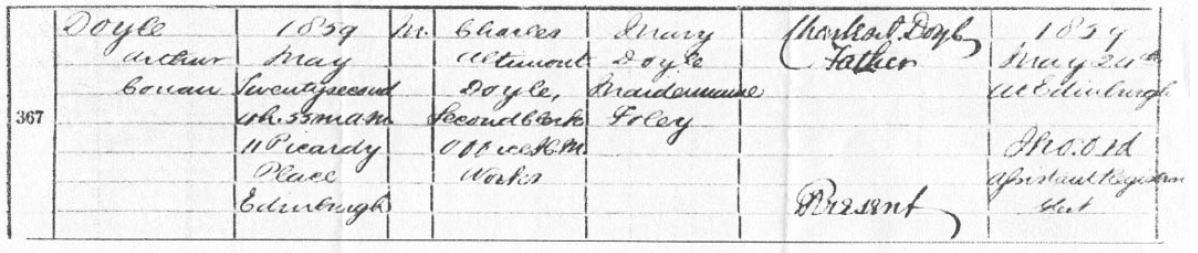
The where and date are easily known:  Arthur Conan Doyle was born on 22 may 1859, at Picardy Place, Edinburgh, Scotland. Knowing the actual time proved to be a problem; I couldn't find it well-documented anywhere. After some chats on twitter last May with folks I know to be knowledgeable (who were also not sure) I landed at the National Records of Scotland web site which includes a scan of Doyle's birth record.

 
The scan is not easy to read. The handwriting is not clear. After much fretting over the second column, I settled on 4:55 am (4h.55m a.m.)  The scan is offered in black and white at the ACD Encylopedia and it might be a tad easier to read. 

 
(A bit of serendipity: The topic came up again this week on twitter. The brilliant Phil Bergem joined the discussion this time. He posted: "The source is the birth registration book for Scotland. Registration District 685 2, entry 367. I make the time recorded as 4:55 am." If Phil says it is 4:55, I believe him.)
 
When C. and I met in May, she  surprised me with a list of traits that might be expected in a person born under the same circumstances as Doyle. From what I've read about him, the list seemed to be a good fit:
 
Sun/Ascendant in Gemini: Intellectual curiosity, sharp mind, quick wit. Enjoys socializing with different types of people. Adaptable and flexible. Excels in communication and convincing people of his own ideas. Once he believes there's nothing left to learn of a situation, boredom sets in and he can become restless.
 
Sun in 1st House: Strong-willed, independent, self-motivated.
 
Moon in Aquarius: Emotionally detached, intelligent, original, independent. Friends are important. Intellect may override feelings.
 
Moon in 9th House:  Yearns to experience different cultures and his worldview (including religious, ethic, moral and philosophical beliefs) is influenced by travel. Emotional well-being tied to educational and intellectual achievements.

Mercury in Taurus: Commonsense approach to situation and values practical ideas.

Mercury in 12th House: Able to get in touch with unconsciousness--may be psychic or intuitive. Has a richly creative imagination, excels in make-believe. Talent in writing fiction or fantasy.

Venus in Aries: Falls in love at first sight. Impatient romantically. Needs a mate who respects his independence.

Venus in 11th House: Love and friendship are of equal importance. Loves intellectual companionship.

Mars in Gemini: Can easily express himself assertively but avoids real conflict. Combines intellect with action. Active and restless mind.

Mars in 1st House: Fiery temperament. Tremendous energy. Impatient.
 
C. explained to me about the influences in some depth. I had to laugh when she said that Doyle may have not always been strongly empathetic and may have been, as one old adage goes, "a mile wide but only inches deep."  I'm not sure about that part but it made me laugh (and think) to hear it. C. is a great lunch companion. 

Doyle might have described his nature in the best possible way in the autobiographical The Stark Munro Letters when he wrote, as Stark:
My father says that I seem to look upon the universe as if it were my property and can't be happy until I know that all is right with it. Well, it does send a glow through me when I seem to catch a glimpse of the light behind the clouds.
I wonder if Doyle's father actually said that to him? I like to think that he did. 
 
(A digression: I'm currently reading a 1928 edition of the book published by John Murray which I quoted here. The emphasis on the word 'does'  caught my eye--it seems unusual for the Doyle works I've read. I also have an 1895 edition published by D. Appleton and Company. There is no emphasis on the word in that printing. Did Doyle actually put an emphasis on it? Argh! I wish I could see the manuscript. Another rabbit hole...)
 
I'm not sure of Doyle's thoughts on Astrology; I've not researched it.  I don't know how he would view this list of possible traits determined from the location of the stars at a point in time. He certainly considered the stars because he told us, again as Stark Munro:
Are you conscious of the restful influence which the stars exert? To me they are the most soothing things in Nature. I am proud to say that I don't know the name of one of them. The glamour and romance would pass away from them if they were all classified and ticketed in one's brain. But when a man is hot and flurried, and full of his own little ruffled dignities and infinitesimal misfortunes, then a star bath is the finest thing in the world.
We have, then, two parts of Doyle: the part that is Sherlock Holmes will not give up precious brain space to store scientific information about the stars as it doesn't help him work, and the part that is Doctor Stark Munro (Doctor Watson?) will not store scientific information about the stars because it robs him of their glamour and romance. 

Well, as C. would tell you, Geminis are known for their dual nature.


Wednesday, September 7, 2022

 "I DESIRE NO DISTRACTIONS..." BUT THIS HAPPENED

Raymond Pallier in Le Petit Journal illustré

'I am very busy just now, and I desire no distractions,' my friend answered.
--"The Adventure of the Three Students"

I've been working (in theory) on a new story inspired by Arthur Conan Doyle's "The Sealed Room" for two weeks now. I've written a total of 730 words. I've stayed very busy with other things-- the news, idly doom-scrolling on Twitter, drinking tea, experimenting with non traditional flours in baking, reading Doyle's The Stark Munro Letters, reading John Lithgow's Poet's Corner, having coffee and book discussions twice with Sherlockian friends, arranging possibilities for a program for the Sound of the Baskervilles in December, and a few other things.  In other words: procrastination fueled by distraction. Today, I acknowedged my failings and had the goal of accomplishing a hopefully interesting blog post about Doyle's gift with writing memorable lines.

I had the pleasure recently of listening to Bob Katz lead a discussion for The Crew of the Barque Lone Star on this topic. Bob noted that Doyle could not only write the brilliant lines that are unforgettable ("'Mr Holmes, they were the footprints of a gigantic hound!'") but he could also write about mundane things in a way that made them memorable ("'It is a lovely evening, my dear Watson,' said a well-known voice.  'I really think that you will be more comfortable outside than in.'") 

One of the best examples I could think of is coal-tar derivatives. ("'Returning to France, I spent some months in a research into the coal-tar derivatives, which I conducted in a laboratory at Montpelier, in the south of France.'") I haven't the faintest idea what a coal-tar derivative is but I never forget that line. 

So, this morning, early, I started a list of the brilliant lines no one ever forgets and a few of the more mundane ones that are not quite as well-remembered but are still great ("'...but I confess that I covet your skull.'") That several hour process led me to the idea that perhaps I should limit my listing to quotes from The Hound of the Baskervilles as Doyle was particularly on fire with great phrasing in that novel. That idea reminded me of a project another Bob (Coghill) did about all the different covers used for HOUN over the years. I stopped what I was doing with the quotes to reread Bob's paper which reminded me that the Arthur Conan Doyle encyclopedia has a section about HOUN covers. I then spent some time looking through those pages.

While there, I came across a set of illustrations for HOUN that I have never paid much attention to, the work of  Raymond Pallier in Le Petit Journal illustré. At that point, all hope I had for seriously accomplishing very much today vanished. These drawings are so different than what I'm accustomed to for HOUN, I got lost in trying to match the illustrations to the specific parts of the tale. This one befuddled me for a minute as I thought it was an execution:

I then realized, of course, it was this: "In the centre of this room there was an upright beam, which had been placed at some period as a support for the old worm-eaten balk of timber which spanned the roof. To this post a figure was tied, so swathed and muffled in sheets which had been used to secure it that one could not for the moment tell whether it was that of a man or a woman.  One towel passed round the throat, and was secured at the back of the pillar."  I had never pictured the moment as being quite like this drawing. If this is accurate, how did Beryl Stapleton survive until rescued? I think her feet need to be on the floor.

Our hero doesn't look at all like I normally imagine him. Holmes's first coat is a bit ill-fitting and unflattering, and he does not wear a deerstalker, but he is quite handsome in his dinner attire. He apparently has a different coat for mucking about in the mire for Stapleton's boot.

It is now three in the afternoon and here I am wondering why my story still only has 730 words. I shall walk a dog and then begin again. I hope I manage to write a memorable line somewhere along the way, perhaps even in this sad tale of a father and son and too many secrets that I will eventually finish. One thing for sure: it will not have anything to do with coal-tar derivatives.


Thursday, August 25, 2022

  IT MIGHT BE A DESCRIPTION OF WATSON

'Yes, there were two of them. They were, as nearly as possible, captured red-handed. We have their footmarks, we have their description; it's ten to one that we trace them. The first fellow was a bit too active, but the second was caught by the under-gardener, and only got away after a struggle. He was a middle-sized, strongly built man — square jaw, thick neck, moustache, a mask over his eyes.''

That's rather vague,' said Sherlock Holmes. 'Why, it might be a description of Watson!'

  --"The Adventure of Charles Augustus Milverton"

Arthur Conan Doyle didn't spill a lot of ink within the Sherlock Holmes canon describing Watson. We certainly know more about Holmes's appearance. Does it matter? Do we need a lot of description of  Watson in order to appreciate who he is? Do we need a lot of adjectives at all when we read? No less than Mark Twain and George Orwell warned other writers against them.

Doyle certainly used adjectives, and used them well. Consider the introduction of Mary Sutherland in "A Case of Identity"-

He had risen from his chair, and was standing between the parted blinds, gazing down into the dull, neutral-tinted London street. Looking over his shoulder I saw that on the pavement opposite there stood a large woman with a heavy fur boa round her neck, and a large curling red feather in a broad-brimmed hat which was tilted in a coquettish Duchess-of-Devonshire fashion over her ear. From under this great panoply she peeped up in a nervous, hesitating fashion at our windows, while her body oscillated backwards and forwards, and her fingers fidgeted with her glove buttons. Suddenly, with a plunge, as of the swimmer who leaves the bank, she hurried across the road, and we heard the sharp clang of the bell.

Doyle's craftsmanship sets a stage for the reader with only 123 words including well-chosen adjectives. I appreciate what he can do with an economy of words. As a writing exercise, I typed the quote above without the adjectives. The paragraph still made sense and moved the story along but a richness vanished. Where is the balance between too many and not enough?

My pondering of this question is affected by Proust. I spent six weeks this summer reading Marcel Proust’s Swann's Way, the first volume of À la recherche du temps perdu (In Search of Lost Time.) Proust is famous, of course, for his long sentences. Many of them in the volume I read (C.K. Scott Moncrieff translation) ran more than 200 words, and one clocks in near 600. 

This does not mean that I did not enjoy reading Proust. He made me think, he made me laugh, he made me angry and once he made me cry. I appreciate his craftsmanship, too. Proust will put 123 words in a sentence before the first comma, with several hundred more words and a lot of commas to follow. 

Neither man is wrong. So, where do I look for inspiration? To them both because they are both masterful story tellers. I do not have the wherewithal to structure like Proust but I can learn from him. I do not have the discipline to structure like Doyle, but I can learn from him.

Earlier this month I spent four days poring over a short story (only 7,700 words), rewriting and rewriting to remove as many adjectives and adverbs as possible. (Yes, I believe Stephen King when it comes to adverbs.) I also axed passive voice constructions and I murdered a few darlings as the old injunction goes. I hope I got the balance right.

In the midst of all this, I read something else that led to many more thoughts about adjectives. Sometimes when the topic is illustrious enough and there are so many possible descriptions, it might be best to cut it to the barest of bones.

At the excellent website Berfrois: Literature, Ideas, Tea,  an intriguing essay by Andre Gerard appeared concerning Doyle's early work and inspirations (including some possible inspirations for Holmes) along with the text of Doyle's "After Cormorants with a Camera."  At the end of the essay, I found this:

About the Authors 
Arthur Conan Doyle was a British writer. He created Sherlock Holmes.
Andre Gerard is a Canadian writer. He created Fathers: A Literary Anthology.

I had to stop and think about how I would describe Arthur Conan Doyle in a brief author's bio. I don't think I could do it as succinctly as Gerard. It takes a sure hand to describe Doyle in 11 words with the emphasis on Holmes. 

After all, "He was a middle-sized, strongly built man — square jaw, thick neck, moustache,..." with an alphabet soup of letters after his name. The Arthur Conan Doyle Encyclopedia has, as part of the header of the home page, "... M.D., Kt, KStJ, D.L., LL.D., Sportsman, Writer, Poet, Politician, Justicer, Spiritualist." Is it lacking without a mention of Holmes?   Certainly there are different purposes between a site header and the end of a blog post but I got lost in a rabbit hole for awhile thinking about how we describe people.

As for Doyle's adjectives, perhaps the situation is as noted in A Life in Letters:  "Sherlock Holmes is a far more vivid presence on the literary landscape than the versatile and intriguing man who created him."

Lovely sentence, that, with excellent adjectives.